Thursday, March 30, 2017

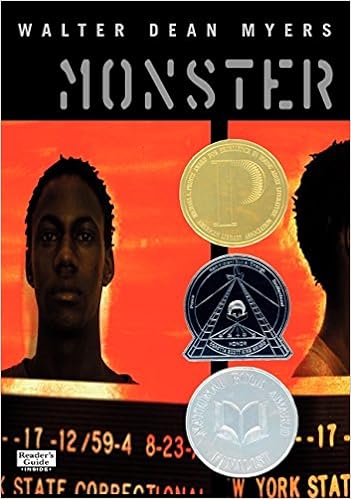
Monster

Image result for monster by myers
Myers, W. D. (1999). Monster.  NY: Harper 

The story is uniquely told via diary and a screenplay,  by 16 year old Steve Harmon, who is an aspiring videographer-writer.  He's in jail, accused of being involved in a heinous crime of robbery/murder in Harlem.  Steve, along with Richard Evans and James King are accused of botching a strong arm robbery, taking the victim's gun and killing him.  From the beginning to the end, the reader is left in suspense on the outcome of the trial and maybe a little unsure how innocent Steve is.  His lawyer, Kathy O'Brien, is definitely not sure he's actually innocent. Steve maintains his innocence, even though the others have confessed to the crime.  Steve is eventually found not guilty.

There is definitely the element of suspense in this novel.  Readers will wonder, and keep wondering.  Readers get a glimpse into innocence lost and most likely a life that they don't want.  The format the book is written in helps keep the reader's attention because it's fragmented- you cannot easily just browse through this book.  I would maybe suggest this book for reluctant readers for the suspense.  Themes that come up in this book are race, peer pressure, and identity- all themes that young adults wrestle with, so there is some identifying with characters, in that.  Monster won the 2000 Printz award.  (Printz awards are given to books that exemplify literary excellence in young adult literature.

Friday, March 24, 2017

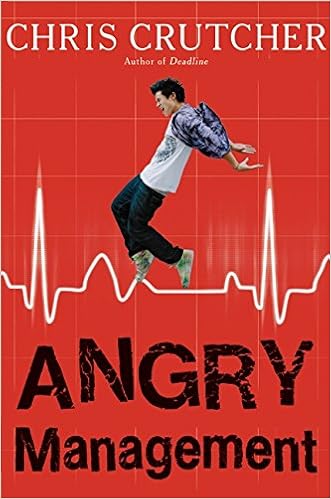
Angry Management

Crutcher, C. (2009). Angry management. NY: HarperCollins 

The story starts off with Mr. Nak, a counselor, who goes on to introduce the main characters of the three novellas that make up Angry Management.  In the first novella, we meet Sarah Byrnes and Angus Bethune.  Sarah was severely burned on her face when she was very young, by her abusive father.  Her mother left shortly after, leaving Sarah behind to be raised by her father.  Angus, a very overweight senior in high school, comes from a very loving mom and dad, who are divorced.  His mom and dad are both gay and married to their significant others.  Angus ends up helping Sarah track down her mom for the second time, only to find that her mom actually had another daughter (she was pregnant with her when she left Sarah and Sarah's father).  Through the course of the story, they become a couple and end up going to work at a place for blind kids, where Sarah seems to grow in confidence and accept that she can still be "shiny" even with her burns.  The second novella introduces us to Montana West and Trey Chase.  Montana, a once popular cheerleader, has turned goth and is trying to get her well written op-ed peace in the school paper.  Her father, who she despises, won't let it happen.  Meanwhile, she meets Trey Chase, a football player who lives with his dying grandmother, when she has to do a peace on the football team.  The two end up becoming a couple, Montana moves in with Trey and his grandmother after a stellar fight with her father about giving up on a child they were fostering.  In the end, Montana and her father have a very public fight at a school board meeting and everyone gets to see her father's true colors.  The third novella introduces us  to Matt Miller and Marcus James.  Marcus James is the only black kid in his school.  He's also gay.  Matt Miller is a Christian state champion wrestler.  The two cross paths when the superintendent declares he will pay a reward for whoever gives up any information about a noose that was found on Marcus' locker.  Matt Miller is the one who tells the crowd he overheard three of the football players laughing about it- which puts a target on Marcus and Matt.  The three football players, one of whom comes from a line of racist and law breaking family members, get suspended from the football team and end up killing Marcus by running him over with a boat, while he was open-water swimming.  In the end, the boys aren't punished because supposedly there was not enough evidence to prove they intentionally ran Marcus over.  Matt quits the wrestling team, because he doesn't want to wrestle for a school that could let such a thing happen, but receives a wrestling scholarship anyways.

This is a tear jerker for sure!  All three stories have moments that make you suck the air.  There's tragedy and triumph and you can't help but keep turning the pages.  There's something to like and something to connect with, with every character, which makes this a great young adult read!  There is consistency with the characters, and stereotypes are blown out of the water as you get to know each character.  Modern readers can relate to every character, on some level, whether their lives look similar or they feel empathetic for the struggles.  Readers who enjoy Angry Management should check out Chris Crutcher's other books: Whale Talk, Staying Fat for Sarah Byrnes, Deadline, Period 8, and The Meat Grinder, to name just a few.   

Thursday, March 16, 2017

Lily and Dunkin

Image result for lily and dunkin
Gephart, D. (2016). Lily and Dunkin.  NY: Delacorte Press.

Told from interchanging perspectives of Lily Jo McGrother (A.K.A. Timothy McGrother) and Dunkin (A.K.A. Norbert Dorfman), this is a story of friendship and courage, and coming to accept oneself.  Lily was born with boy parts but has known all her life that she is a girl.  The summer before 8th grade, with the help and encouragement of her friend, Dare, shes decided to be brave and make some changes.  In addition, she begs her mom and dad to get her the expensive hormone blockers that will help keep her body from developing into a man.  Lily's got the support and love of her sister, Sarah, her mom, and her best friend Dare.  She gets picked on constantly by a group of boys she calls the "neanderthals".  Her dad and grandmom are also less than supportive of Tim being Lily.  Through the coarse of the book, Lily gets braver and braves- painting her nails, wearing Sarah's makeup, and finally starting the hormone blockers (that her dad has agreed to, after seeing a psychologist), and dressing up as a very feminine mermaid for Halloween- which leads to her biggest goal yet- to go dressed as a girl to the holiday dance.  Lily's path crosses with Norbert's right before the start of 8th grade.  Lily dubs him Dunkin, as he hates his name.  Dunkin has moved from New Jersey with his mom, to live with his grandmother in Florida.  Through the unfolding of the story, it is discovered that Dunkin suffers from Bipolar disorder, just as his father.  Because Dunkin wants to impress the boys on the basketball team, that he made simply because he was tall, he quits taking his medication which ultimately leads to him having to be hospitalized.  Before being hospitalized, Lily confides in Dunkin about how she feels like she is a girl in a boy's body and Dunkin is accepting of the shocking news.  During Dunkan's hospitalization, he finally comes to terms with his father's death and his own need for medication.  Dunkin shows up at the dance thinking he will need to protect Lily from the neanderthals and finds that she is fully dressed as Lily.  The two dance the final dance together and Lily's father shows up fully supporting her new look.

In true Donna Gephart style, the facts aren't told all at once, but come to be known to the reader bit by bit.  It's a technique that keeps the reader reading.  Covering two hard topics in one book was a big undertaking- especially considering the taboo topic of transgendered children.  Gephart's characters are believable and easily help the reader to connect in one way or another.  The characters of Lily and Dunkin help open the eyes of readers who may otherwise have zero experience with transgender people or those with Bipolar disorder.  It allows a window into the world of their struggles and triumphs.  Gephart does a great job of keeping everything real and avoiding any stereotypes.  The characters- both kids and adults, are believable and relatable.  Here is a book trailer for Lilly and Dunkin.   

The Nazi Hunters

Image result for nazi hunters

Bascomb, N. (2013). The Nazi hunters. New York: Arthur A. Levine Books. 

A nonfiction account of hunting down one of the Nazi regimes most notorious leaders in the genocide of 6 million Jews during World War II, Adolf Eichmann.  Tending to go back in forth between relaying the facts and story telling, the book recounts stories of Adolf Eichmann from Holocaust survivors and the crew of Mossad agents that took part in the hunting down, abduction, and return of Eichmann to stand trial in Israel.  The Nazi Hunters tells the story of Adolf Eichmann's leading role in the extermination of Jews starting with his plan of rounding up the Jews and cramming them into gettos and then sending them off to the concentration camps where they were either immediately executed or worked to death.  When a girl in Argentina discovers that the boy she had been in a previous relationship with was possibly the son of the Nazi, Adolf Eichmann, she tells her dad and the story of confirming Eichmann's identity and subsequent retrieval from Argentina so he can stand trial, unfolds.  The details of the Mossad team's actions to locate Eichmann, positively identify him, capture him and then transport him from Argentina to Israel are emotional and tense, as everyone involved in the mission lost loved ones in the Holocaust.  Once Eichmann is successfully brought to Israel for trial, he is found guilty (even after maintaining innocence and that he was simply following orders) and sentenced to death.  The trial served two purposes- justification as well as a means to share the atrocities of the Holocaust with the world.  Prior to the trial, many survivors did not share their experiences and this trial opened the eyes of the world to the tragedies and suffering of an innocent people.

Select by YASLA as a top nonficiton read for young adults, this book is both educational and emotional.  Although not necessarily an intensely suspenseful page turner, it definitely keeps the reader wanting to learn more in a way not extremely typical of nonfiction books.  Neal Bascomb spent time traveling four continents, interviewing Mossad spies, tracking down former Nazi's in Argentina, and looking through rarely seen German archives.  Bascomb admits in his author's note that he did the best job he could, to accurately tell a spy story that, because of the confidentiality, had some elements missing.  Additionally, Bascomb states that there were some inconsistencies and conflicts between the stories of the events told by those he interviewed.  He shares the discrepancies in his notes section.  From all the research and facts known to the public, this story is as factually accurate as one could ever hope for it to be.  Throughout the book, there are photographs of the people involved, as well as some of the artifacts actually used in the mission.  Here is a book trailer for Neal bascomb's The Nazi Hunters.  

Thursday, March 9, 2017

Human Body Theater

Image result for human body theater
Wicks, M. (2015). Human body theater. A nonfiction revue. New York: First Second

A non-fiction graphic novel all about the human body, humorously narrated by a skeleton that adds a layer at each act, to eventually become "a fully formed human being." Each act gives facts, and sometimes quick anecdotes, jokes, and random facts, about the different body systems.  The characters in each act are made up by the different components of that particular system.  The book also includes a glossary of terms in the back.  

What a great way to explain the functions and components of the human body systems!  It is clear why this book is on the list of Great Graphic Novels for Teens!  The characters are funny, the text is easy to read, the vocabulary is well defined and accompanied by pictures and facts to help one remember the components.  This would be such an excellent resource to use during a human body unit.  Students would definitely appreciate the vacation from boring text books, and this book has all the facts to ensure you wouldn't have to revert to a textbook.  The full-colored graphics are eye-catching as well as detailed and helpful in creating visuals for the reader.  Read from left to right and top to bottom (unless there is a full page diagram), the book is not made up entirely of the same kinds frames- in fact, frames vary throughout the book.  Many of the pages with lots of facts have typical frames.  Some pages have frames with a few frameless illustrations.  Space is excellently used throughout the entire book.  

Other books on the same topic, that readers may find useful, include: The Way We Work: Getting to Know the Human Body by David Macaulay; The Human Body: An Illustrated Guide to its Structure, Function, and Disorders by Dr. Charles Clayman; Human Body by Steve Parker.  

Sunday, March 5, 2017

Winger

Image result for winger andrew smith
Smith, A., &Bosma, S. (2013). Winger. New York: Simon &Schuster Children's Pub. 

Ryan Dean Smith (aka Winger) is a 14 year old Junior at Pine Mountain boarding school.  He hates being treated and viewed as just a kid, especially by his best friend, and love interest, Annie.  Told from Ryan Dean's perspective, he chronicles his Junior year- being on the rugby team, having to live in Opportunity Hall with the delinquents of the PM (and rooming with Chas Becker, the scariest and meanest kid on his rugby team), playing rugby, his hormonal tendencies to find just about every girl and woman he sees as hot (and rates them on different Ryan Dean West scales), and the friendships that he both ruins and discovers.  Throughout the story of his junior year, Ryan West speaks to the reader and also shares his funny cartoons.  The climax of the plot happens just before the end, when one of Ryan Dean's best friends, Joey, is found beaten to death.  Joey was gay and everyone knew it and most everyone was fine with it because Joey was a good guy.  The story quickly wraps up with finding out it was two football players who brutally and drunkenly murdered Joey (one of whom was secretly hitting on Joey).  Ryan Dean finds comfort from Annie, his now girlfriend, and mends broken friendships.  

This book, although heavy at the end, is quite hysterical.  Smith writes with the humor, sarcasm, and perversion of a teenage boy.  Between the laughable and embarrassing happenings of Ryan Dean, his sarcasm, and his cartoons, the reader can't help but like the kid.  There's just enough suspense to keep the reader turning the pages, but Joey's death sneaks up on the reader at the end and keeps the reader wanting more to read.  The story wraps up pretty abruptly.  The characters are consistent with the real world that kids live in today- the way that Winger interacts and talks with his buddies, the thoughts he has about girls/women, the speech of the characters- it's all there.  This could be a great book to rope in reluctant readers.   

Speak

Image result for speak by anderson, l
Anderson, L. H. (1999). Speak. NY: Penguin

After calling the cops during a party at the end of the summer, Melinda Sordino starts off her freshman year of high school a pariah.  Nobody she's known for the last 9 years of her life will talk to her, except for Heather,  a new girl from Ohio.  But nobody knows the real truth and Melinda can't seem to find her voice.  She barely speaks to her parents, who seem to barely be holding on to their marriage.  She's doing horrible in school, when last year she was a solid B student.  Her only saving grace at school is an old abandoned janitor closet she has transformed into her personal sanctuary and art class.  Slowly the story unfolds and the reader learns the truth, as is probably suspected from subtle hints from the beginning- Malinda Sordino was raped at the party and that's why she called the cops.  But instead of speaking up to the cops, she ran and nobody ever knew the truth.  Eventually, the boy who raped her, Andy Evans, turns his attention to Malinda's ex-best friend, Rachel/Rachelle and that's what helps Malinda to find her voice- she wants to protect Rachel.  Slowly she starts to become human again and interact with the people around her.  In the end, Andy tries attacking Malinda again, since she spoke up and rumors are going around about what a terrible guy he is.  She saves herself just in the nick of time, and the rumors end up being publicly justified.

Malinda's character reflects a lot of young adults- too scared, embarrassed, or ashamed to speak up about bad things happening to them.  For someone who hasn't experienced sexual assault, it might be easy to assume it's weakness that keeps people from telling someone, but Malinda gives us a first hand view of what could be going through that person's mind.  The strong writing really helps the reader to feel what Malinda is feeling.  Young Adults can most likely relate to where she is coming from during many of the scenes.  This is an eye opening novel and one that will literally speak to every person who has been an a victim and even to those who thankfully have not. Anderson's writing sucks the reader in and keeps them turning the pages.  Readers will find themselves feeling the pain and triumph of this story.

Other novels by Laurie Halse Anderson include: The Impossible Knife of Memory, Wintergirls,
Forge, Chains, Twisted, Prom, Catalyst, and Fever 1973.