Monday, April 17, 2017

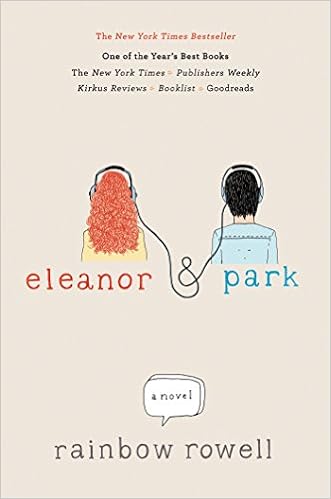
Eleanor & Park

Rowell, R. (2013). Elanor & Park.  NY: St. Martin's Griffin. 

Eleanor has been welcomed back "home" to where her mom, stepdad, and four younger siblings live.  Eleanor was previously kicked out after fighting with her stepdad.  She's a larger girl with a full head of red curly hair and a strange sense of style.  She meets Park, a half Korean, half-white, fellow sophomore, on the bus.  When none of the "hell children" on the bus will let Eleanor sit with them, Park relents.  Eventually a silent relationship begins to slowly form over comics and then music.  And then the bus relationship turns into a public relationship that Eleanor has to hide from her despicable stepfather.


This book had me sucked in before page 30.  It’s written in a way where background information is slowly exposed, which keeps the reader turning the pages.  I was dying laughing with the sarcasm and crying at the heartache, loss, and misfortune.  I found myself crying and then laughing in the same paragraph at times.  I loved the voice!  The book definitely has some strong language content and deep subject content as well.  I wouldn’t necessarily have this book shelved in a junior high library, but I couldn’t keep this away from high schoolers.  There’s so many windows into different worlds and ways that high schoolers could find to relate to the characters- either because they're living similar situations or they have no idea that's how life can be.  Rainbow Rowell took me back to parts of high school that I had forgotten- both a painful and grateful thing!  

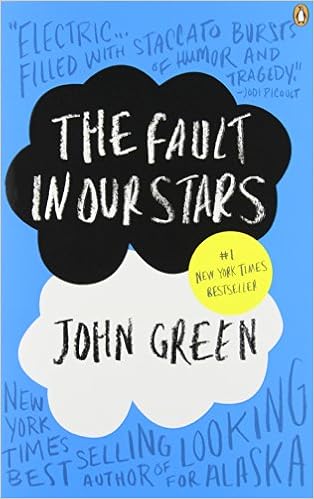
The Fault In Our Stars

Green, J. (2015). The fault in our stars.  London: Penguin. 
Hazel meets Augustus, a former star basketball player, at the cancer support group meeting. After hanging out, they agree to rread each other’s favorite books.  Hazel’s favorite books is An Imperial Affliction  by Peter Van Houton, which maddingly leaves her asking questions.  They use their “cancer perks” to take a trip to track down Van Houton, who ends up a drunk and not helping them.  Augustus reveals that his cancer has spread everywhere and shortly after returning from the trip, Gus passes away.  Van Houton ends up attending Gus’ funeral and talking a bit more to Hazel.  She loses the love of her life, but she finally gets closure to her ultimate worry- that her parents will be okay, after she dies. 
Two teenagers struggle to find meaning in their short lives while dealing with the deadly cancer that dominates their thinking.  No topic is too sacred to explore.  Characters boldly expose their emotions, their view of life, death and the afterlife.  It seems they have no time to waste on their own mortality, that fate having been sealed. Poignant with wry humor and sarcasm, this book gives insight into adolescent compassion and anxiety.  The characters are believable and relatable.  Here is a book trailer for the novel.  

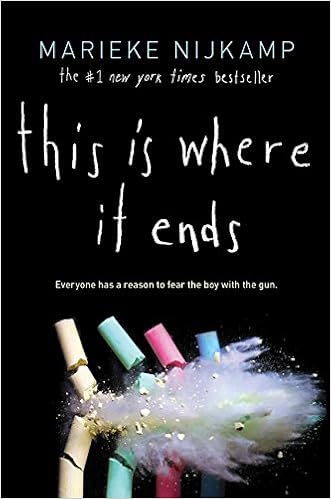
This is Where it Ends

Nijkamp, M. (2016). This is where it ends.  Illinois: Sourcebooks Fire.  

The story of a tragic high school shooting is told from the perspective of four students.  Claire, a senior and sergeant of the JROTC.  She’s not in the assembly because she and other members of the track team are practicing.  Her brother, Matt is inside the auditorium.  Thomas is skipping the assembly with Farheed- breaking into the principal’s office in search of a permanent record.  His sister Sylv is in the assembly and also adds perspective from inside the auditorium.  Sylv’s girlfriend, Autumn, is the final perspective.   Autumn’s brother, Tyler, is the terrorizing shooter.  He feels abandoned by everyone after the death of he and Autumn’s mom.  Thomas and Farheed end up getting the doors open and many students and staff to safety, but the ordeal doesn’t end until Thomas has sacrificed his life for his sister and Tyler has killed himself.  In the final scene recounted by Sylv, the surviving members of Opportunity High School meet to mourn their fallen classmates and coworkers.

A window into a world everyone prays they never experience!  The varying perspectives of the story add to the element of suspense.  The details of how everyone is connected are stretched out over the length of the book, which adds an interesting almost component that makes you want to go back and re-read parts.  Additionally, there are inserts of tweets and a blog, that help the reader to really feel the desperation and fear of the situation.  This is Where it Ends has found itself on the New York Times bestseller’s list for good reason.  It’s not a topic often read about in fiction writing- a delicate matter has been tackled, and the ugliness, terror, and tragedy is not glossed over.  Mareike Nijkamp’s next book, Before I let Go, will be out in January of 2018.  

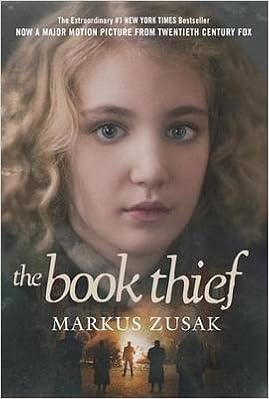
The Book Theif

Zusak, M. (2005). The book thief.  NY: Alfred A. Knopf.

9 year old Liesel Meminger is living Nazi Germany.  After the death of her brother, her mom sends her off to live with an older couple- Hans Hubermann is gentle and kind and Rosa Hubermann is a short tempered woman not to be crossed.  Liesel begins learning to read, with the help of Hans.  Liesel’s best friend and neighbor, Rudy, is poster boy for German child and with Liesel when she first gets into the Mayor’s house to look at all the books.  One night, the town has a bonfire where they destroy books, but Liesel ends up stealing one.  She’s unkowingly seen by the mayor’s wife.  Liesel also befriends Max, a Jew that the Hubermanns hide in their basement.  When Hans gives a Jew a piece of bread, he puts everyone in danger.  Max has to leave and Hans gets drafted.  An air raid ends up killing Hans, Rosa, and Rudy, but somehow Liesel survives.  Max also ends up surviving the war.  Liesel eventually moves to Australia where Death comes to take her, as an old woman. 
Interestingly, this story is narrated by Death.  It’s really a uniquely written story with several literary elements.  Obviously Death is personified.  Underlying themes of the book are death and love.  The Book Thief is a Printz Honor Book- an award for quality literature for teens.  The masterful writing is really unique- definitely not a quick read.  It makes for a beautiful and exceptionally told story.  Readers will find themselves with their hearts racing, jaws dropped, and tears flowing.  Occasionally there’s even a laugh to be had.  Zusak also wrote I am the Messenger, which may be another book worth reading for those who enjoy The Book Thief.  

Sunday, April 16, 2017

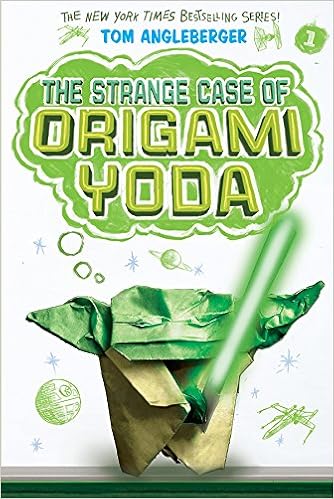
The Strange Case of Origami Yoda

Angleberger, T. (2010). The strange case of origami Yoda. NY: Amulet Books.

Tommy, a 6th grade student, is on a mission to figure out of the origami Yoda that a strange kid in his 6th grade class, Dwight, wears on his finger.  The strange thing is, Origami Yoda didn't just help Tommy out in some situations, but he helped out other classmates too, in some ways that seemed like he could tell the future.  It doesn’t seem like Dwight has the brain capacity to be the wise Yoda.  So Tommy starts creating a little case file collection of first-hand accounts.  The accounts relay events that happened and how Origami Yoda advised the person telling the story.  At the end of each account, Tommy makes a comment, and so does his friend, Harvey.  Tommy is convinced Origami Yoda is real, while Harvey is not.  Harvey ends up creating his own Origami Yoda and competing with Dwight’s.  In the end, it’s left to the reader to decide if Origami Yoda is Dwight or he’s Dwight filled with the force. 


A fun quick read for the younger end of the spectrum of Young Adult Literature.  This is a great book to exemplify voice in writing, since there’s different stories written from the points of view of different characters.  The plot is intriguing and pretty funny as well.  Similarly aged students will find themselves relating to the different characters (and older readers might find themselves flashing back to the awkwardness of 6th grade!).  Tom Angleberger has written as series of Origami Yoda books that have become a New York Times Bestselling Series.  Interestingly, Angleberger has also written under the name “Sam Riddleburger.” Here’s a book trailer for Origami Yoda.  

Wednesday, April 12, 2017

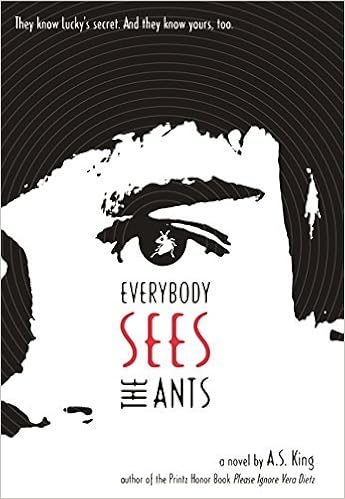
Everybody Sees the Ants

King, A. (2011). Everybody sees the ants. NY: Little, Brown, and Company.

Lucky Linderman has been abused by a bully, Nader McMillan, since third grade.  Nader has also bullied and assaulted a classmate, Charlotte, on several occasions.   The bullying resolution and dreams about his grandfather are the core of the story line.  The haunting dilemmas are dreams of Lucky’s name sake and paternal grandfather, Harry “Lucky” Linderman, a Viet Nam MIA/POW and his dysfunctional parents.  Each chapter has the dream “visits” with his grandfather, where Lucky attempts to “save” his grandfather throughout many of the dreams.  The ants are throughout the book and seem to represent small, vulnerable characters conjured up to support Lucky, an only child who is small, immature and vulnerable (especially to the bully).  After an incident with Nadar at the pool, Lucky and his mom go to Arizona to visit family for a few weeks.  During his visit in Arizona, Lucky meets Ginna, a beautiful 17 year old girl.  They become friends and she helps improve his confidence.  After the trip, Lucky communicates more effectively with his parents and begins a more adult-like relationship with them.  Lucky decides to confront Nader and tell him he will report him to the police if he bullies him or others again.  Nader relents and Lucky feels a sense of relief and maturity after confronting him.  Lucky seems to be set free during his last dream, where his grandfather happily enters a prepared grave.

Everybody Sees the Ants is serious with quips of humor.  With the believable characters and dialogue, young adult readers will find themselves identifying with or feeling empathetic. Bullying is a theme throughout the book.  This is King's third young adult novel.  She is a Printz award winner for her second novel, Please Ignore Vera Dietz.  Here is a book trailer for Everbody Sees the Ants.   

Friday, April 7, 2017

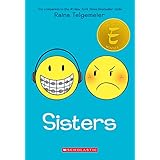
Sisters

Product Details
Telgameier, R. (2014) Sisters. NY: Graphix. 

A memoir like graphic novel written by Raina Telgameier.  Raina tells about a a road trip from California to Colorado, with her mom, younger sister, and younger brother.  On the way to visiting family in Colorado, Raina it is evident that the sisters have a hairy relationship- always getting on each other's nerves and annoyed with one another.  Through a series of flashbacks, the readers sees how Raina couldn't wait to have a baby sister and how the relationship wasn't what she thought it would be.  Eventually, the sisters discover that their mom and dad are having some marital issues and they figure out how to get along.

The graphics play a big role in the story because there is not a whole lot of writing.  An interesting technique is used for the flashbacks- current narration occurs with frames on white paper, while the flashbacks are frames on yellowed paper.  The illustrations tell as much of the story as the words, which would be great for readers who aren't too interested in wordy novels.  This graphic novel might be a great way to get the younger end of reluctant young adult readers.  In addition, readers who struggle with complicated plots, might really enjoy the simplicity and humor found in Telgameier's books.  Students who enjoy this book, would most likely enjoy Telgameier's precursor, Smile.